
They Wont Go When I Go
A more naturalistic yet imagined setting occurs in the 2020 version of When I’m Dead My Dearest and Requiem. I painted these works in my Bronx studio when Covid-19 was shutting down New York City. With reliable roots in the city, I was ready to readdress this painting concept in a way that was more representative of the space and growth I had cultivated in the years since moving from the South. These paintings were imagined and remembered compositions without being worked from a reference. The mental recollection of this technique lends to abstracted environments and less accurate figurative anatomy.
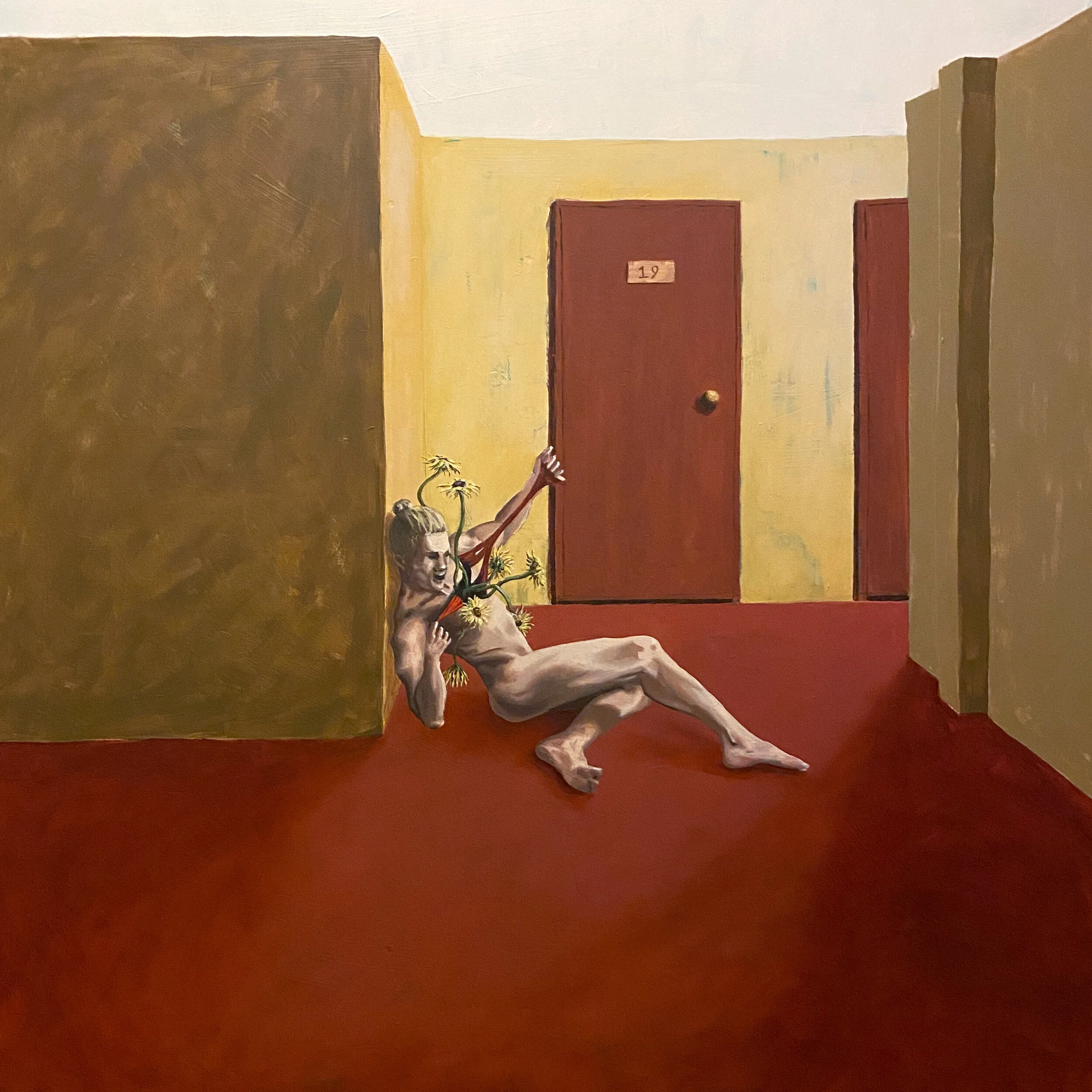
Requiem (2020)
oil on panel- 48 X 48
This rendition of Requiem portrays the flatly lit hallway of the Lakonia Hotel in Sparta, Greece, where I received the call about Steve’s death. I spent hours there, as it was the only spot close to my hotel room with strong enough Wi-Fi to make calls to the States. The figure depicted on the floor represents a grieving person. He is small in the space. He is screaming while sunflowers burst from his chest. The door number in the background is nineteen, Steve’s age when he died. The fluorescent light dulls the scene and mutes the colors to evoke a feeling of discomfort. Peeking through the large color forms is the Stevenson poem, “Requiem.”

With long hair and a lack of tattoos, this self-portrait harks back to the way I looked in 2017 while on my work study in Greece. The scene itself is the hallway of the Lakonia Hotel, where I spent the night after learning of my friend Steve’s death. The setting is painted from what I can remember from the night, where the dark red carpet and fluorescent lighting added to the uncomfortable feeling.
Like the 2018 version of “Requiem”, the sunflowers ripping out of my chest show the painful growth we experience in grief. In the underpainting of the panel, Stevenson’s poem by the same name is visible in the painted-over letters.

When I’m Dead My Dearest (2020)
oil on panel- 48 X 48
Like the 2018 version, the 2020 painting shows the Rossetti poem behind a dark background. The whole figure is kneeling in a granite grave plot and represents death. There is a bed of ivy and a large tree that grow from the grave. Caught in a camera flash at night, the figure struggles with the ivy vine around his neck. Again, it is unclear whether he is tightening or removing the vine.
This piece is reimagined from the 2018 painting of the same name. In the same context, this work depicts an imagined figure of Steve fighting with a vine of ivy around his neck. The viewer can't tell if he is tightening the vine or pulling it off of his throat. This struggle is associated with the struggle that Steve encountered with mental health in the months leading up to his death in 2017. In the setting of this work, the figure is kneeling in a granite grave plot surrounded by ivy as is the case with Steve’s family grave plot in Clemson where he is buried.
The thick lettering to Rossetti’s poem, “When I’m Dead My Dearest”, is visible under the layers in the underpainting, and peeks through in the yellow specks of the background.