
They Wont Go When I Go
I painted Requiem and When I’m Dead My Dearest simultaneously, bouncing back and forth between the panels. I started the paintings before really knowing what would come from them. Having used poetry in a class assignment the previous semester, I found that implementing it in my work was an effective way to arrange my thoughts.
I did these works in the late fall following Steve’s death in the summer. In Brevard, a comfortable and personal environment, I was able to begin to process my thoughts. This developed as a large, bright, and violent work.
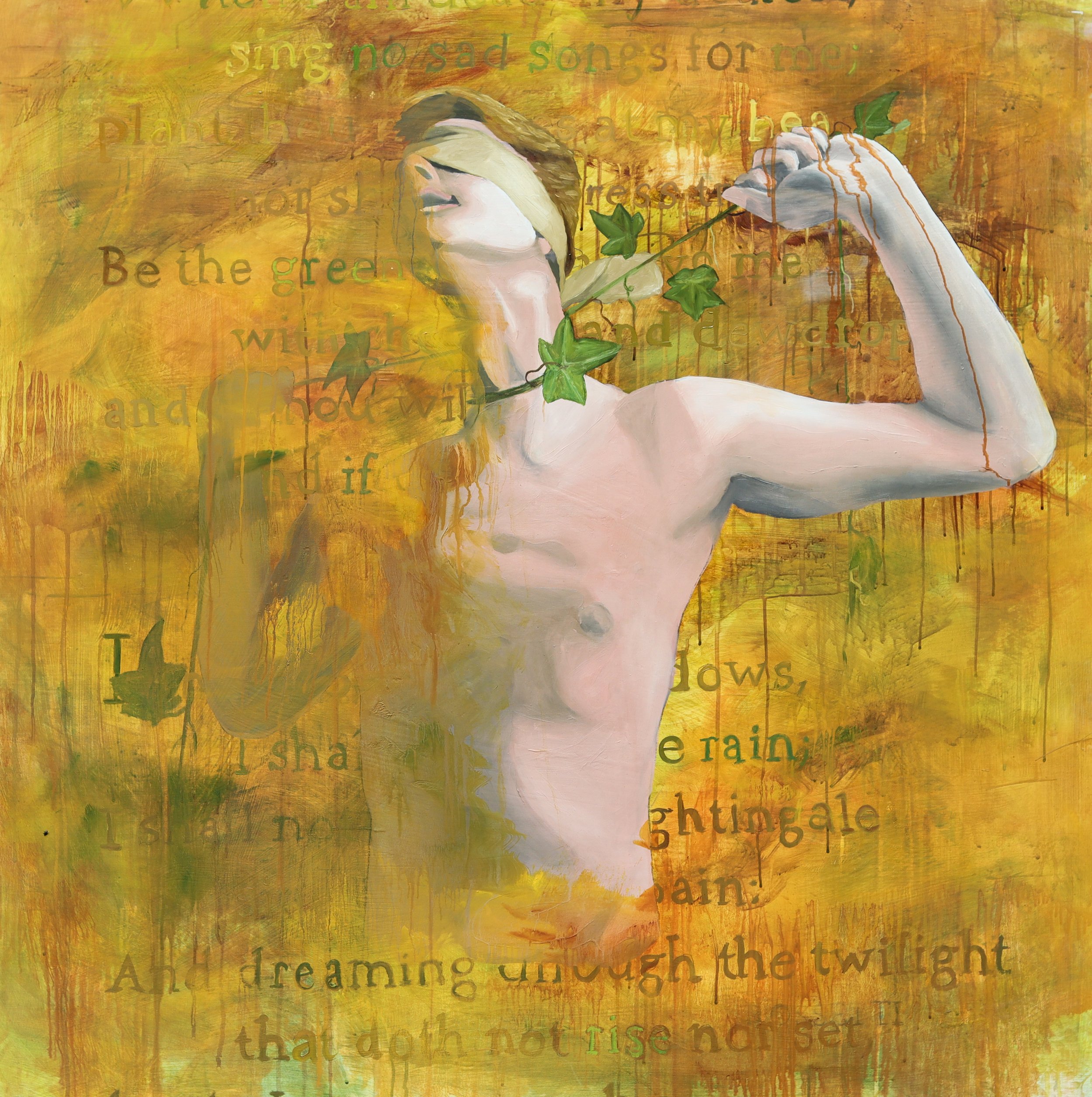
When I’m Dead My Dearest
oil on panel- 48 X 48
In When I’m Dead My Dearest, I painted the yellow background with the Christina Rossetti poem of the same name. The subject of the poem is addressing a loved one. They urge this person not to focus on grieving too much. They acknowledge that no one knows what happens to us after death but instruct the loved one to be a positive influence in the world. Death is represented in this painting by the strip of canvas covering the eyes of the face. The ivy wrapped around the neck of the figure exhibits a violent narrative; the viewer should question if the ivy is being pulled from the neck- or tightened. Often ambiguous, mental health struggles raise questions for an outside viewer.

This work, along with Requiem, is the first painting to be inspired by the unexpected death of my friend Steve in 2017. In this piece, my figure is used as a symbol of Steve. The raw canvas pulled over my eyes denotes death. The ivy in my hands and around my neck is a nod to the bed of ivy that surrounds Steve’s grave, while to the viewer, it is not obvious the figure is strangling himself with the ivy or trying to pull it off of his neck. The struggle of the figure is presented to signify the mental struggle Steve was facing in the months leading up to his passing. Behind the figure, in a wash of yellow, the Rossetti poem, “When I’m Dead My Dearest” provides the structure of the composition. This piece, meant to be shown with Requiem, is from the perspective of Steve, as the poem is from the viewpoint of the deceased. -First place in Brevard College 2018 Juried Art Show.

Requiem
oil on panel- 48 x 48
The poem “Requiem” by Robert Stevenson, painted in the background, concludes with a eulogy to a loved one. This role of the eulogizer inspired me to present this figure as the griever. The figure is painted, ripping open a cavity in his chest as a sunflower burst forth. This expression demonstrates the pain I was going through in my early stages of grief. It also acknowledges the beautiful parts of growing through hardship- I was being pushed into this reality and needed to embrace it. While painful, the silver lining is developing a deeper understanding of the human condition and a greater capacity for empathy.
Shrouded in a wash of varied greens, this figure, along with When I'm Dead My Dearest, are the first pieces created in the wake of my friend Steve’s death. From the perspective of a mourner, this work depicts my state after his death. The grief from this time was a painful thing for me to face, while it also had the silver lining of better understanding my friends and family, being more available for others’ similar grief, and inspiring me to pursue more worthwhile goals. This dance between pain and acceptance is shown through ripping out the sunflower from my chest. An act both painful and beautiful. In the space around my torso, “Requiem” by Stevenson is written into the cloud of green.- First place in Brevard College 2018 Juried Art Show.